


Articles > Attachment parenting on the move - low budget backpacking travel with babies and young children
Attachment parenting on the move - low budget backpacking travel with babies and young children
'A Month in Morocco With My 7 Month Old Twins'
"Twem?" "Eeyeh", I reply. Yes, twins. "Seba'a shHoor – jooj wiled" Seven months – two boys. They mimic and chuckle over my primitive Arabic, but the ice has been broken. No longer are we part of the amorphous mass of tourists – we are a Family, travelling around their country. We have slid below the tourist hustle; moved marginally closer to these people.
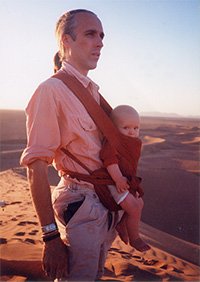 For most travellers, the arrival of children means the abrupt exit of their backpacking travel days. But, soon after our twins arrived, we had started planning our next backpacking trip – to Morocco, having decided that, since we had taken the babies with us everywhere, nothing would stop us continuing with a travelling way of life. Practising what is now called attachment parenting, we had carried them from birth and, avoiding the supposed convenience of a pushchair, we had a backpack each on our backs and a baby slung on the front.
Even though it has become a popular package destination, the idea of a month's low budget backpacking trip around Morocco with seven month old twins produced an unexpected reaction – we were considered by most people to be, at the very least, brave, if not foolhardy … or completely mad.
But travelling with our babies proved to be richly rewarding and, avoiding expensive hotels, our extremely low budget meant that we had much more opportunity to engage with local people than most families, labouring under the mistaken impression that there is something inherently dangerous about any less developed country. Also - and we had not known this before our trip - twins are considered very lucky in Morocco; we were told many times that, not only were we lucky, but that we had brought luck on them and indeed on the whole world. My wife, Mary-Clare was regarded as a blessed woman and it was considered that Allah had indeed smiled on us.
Despite television adverts promoting formula milk and bottle-feeding – as a necessary part of a 'civilised' Western way of life – the concepts of attachment parenting and long-term breastfeeding are happily entrenched in Moroccan life - and, come to that, all Islamic teaching on the subject. A breastfeeding mother (especially of twin boys) is approved of, particularly by old men, since the Koran states that boys should be breastfed until the age of two. However, it is undoubtedly the case that boys are considered more important and it is thought that they take time to 'form' as people and therefore need care and protection for a protracted period of time – prolonged breastfeeding forms a part of this approach. Girls, in contrast, need only be nursed for 18 months, but rather than dismiss this as another example of how Islam treats women as second-class citizens, it is interesting to note that the idea ties in with studies which have demonstrated the comparative greater vulnerability of boys – more stillbirths, more premature births and, later in their lives, more suicides.
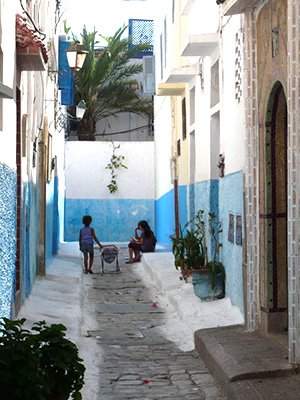 Unlike in our own culture, the young men love babies too and have an easy way with them: in restaurants, Arran and Fingal would be taken off by the waiters to be shown to their sisters or mothers. Many times, as Mary-Clare struggled, squatting, to breastfeed one of the babies on a dusty pavement, a young man would rush out from his shop across the busy road with a stool, or beckon us in to sit indoors, whilst he chatted to me and laughed and cooed at the boys.
In contrast, the picture of Morocco painted by even the 'alternative' guidebooks is of a difficult country for Westerners to cope with. The social conditions – 25% official unemployment [my note - now below 10%], no welfare state to fall back on and much of the population scraping a living from self-employment – encourage many Moroccans to treat tourists as a convenient meal ticket.
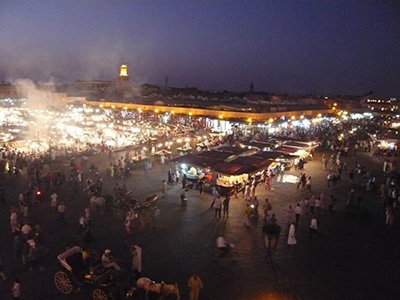
In the large towns, hustling – for hotel rooms, restaurants, taxis, gift shops, even phonecard units – is a way of life. Marrakesh, in particular, can be a trying experience: every shop owner exhorts you to come in and "just look"; every restaurant waiter wants you to eat there. The options can dwindle to switching off (and thus missing out on communicating with naturally friendly people), or rudely rebuffing any approaches.
For us, our low budget backpacking trip meant continual interaction with local people and our twins proved great allies in enabling us to move below the frantic tourist hustle and uncover the warmth and hospitality which our modern society so often seems to lack. All but the most hardened hustler would soften at the sight of our blond 'angels' – kiss them, spend a few minutes pulling faces and then wave us on our way with a smiling "welcome to Morocco".
Our month-long backpacking trip saw us moving from Tangier in the north, towards the pre-Sahara in the far south. With family in the country, we were able to spend time deep in the Medina of Fes and in Moulay Idriss – the holy town founded by Idriss, the creator of Arab Morocco, which was closed to non-Muslims until the 1920's and in which it is still forbidden for 'Christians' to stay, except as guests of a Moroccan family.
In Moulay Idriss, we were relentlessly stared at. They are less used to Western backpackers than in other towns – although, as a place of pilgrimage second in importance only to Mecca, visitors are numerous and welcome. The centre of the town is packed with small kiosks and shops selling trinkets to the faithful; or nougat, a speciality of the area, piled in sticky, pastel-coloured mounds.
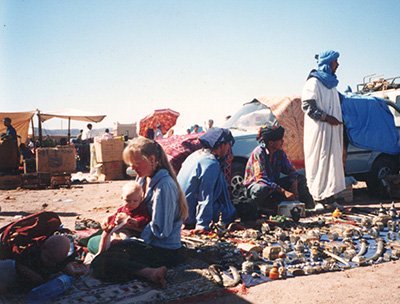
 It is sometimes difficult to appreciate the staring for what it is – unashamed interest – rather than resurrecting our childhood admonition, "it's rude to stare"! Further south, African Morocco became very apparent – easily overlooked in what often seems more of a middle-eastern country. In Tamegroute, just 35 miles from the Algerian border and 7 miles from the Saharan dunes at Tinfou, we were surrounded by crowds of dark-skinned, bare-footed children. The previous mild discomfort of staring was superceded by an oppressive chanting for dirhams, "bonbons", or "cadeaux" and the uneasy realisation that they could not be shaken off like a tourist guide in Marrakesh.
However, from north to south, everywhere we went, Arran and Fingal were to smooth official difficulties and ensure special treatment. At Tangier airport, late at night, we were the only people waved through with a smile, whilst the customs men officiously and meticulously searched through everyone else's baggage. The soldiers, casually sauntering around the airport, armed with machine-guns, surrounded us, but only to win smiles from the boys and find out their age, where we were from, had we been here before, etc, etc.
In the taxi from the airport, at one of the road-blocks which are all too frequent in Morocco, with the constant fear of fundamentalist terrorism spreading from Algeria, the high-powered flashlights picked out our sleeping babies. "Twem?" – more smiles, more happy waving. As we moved off, they were chattering and laughing to each other about this wonderful sight!
 Apart from the occasional tourist, the only prams or push-chairs we saw were in the capital city, Rabat – a symbol, amongst the smart, modern young women, of their aspirational Western lifestyle. Moroccans naturally practise attachment parenting without having read a book about it (!) and are used to seeing babies and toddlers carried, but we never managed to master their casual method of baby-carrying – a shawl tied over one shoulder, with the child wobbling about behind, stuffed in with no apparent regard for comfort. The small faces already bore that strange expression of stoical, resigned acceptance that one sees so often throughout the Third World.
In contrast, we had our nice, Western, manufactured baby carriers, with the boys facing out. As backpackers, with our rucksacks on, it was obvious why they were on the front, but we were repeatedly told that they should be on our backs.
However, we gave Moroccans the chance to indulge in one of their favourite occupations – kissing. It was mostly gentle and good-humoured. But I wonder if Arran and Fingal, in their nightmares, might remember the fierce, bearded madman looming in on them at the Oudaia Gate in Rabat, tightly gripping my arm, as I backed off, repeating "safi! safi!". Enough! Enough! Or the toothless old woman in a café in Chaouen, who bestowed luck on them with her frenzied shrieking and showers of kisses and required us to recognise our good fortune with a few dirhams. And throughout the country, especially in the extraordinary, packed medina (the old city) of Fes – beaming smiles, peals of laughter, "twem?", or "jumeaux?" if they thought that French would serve better.
It was Fes, more than anywhere else we visited, which captivated me. The most complete mediæval city in the Arab world, Fes El Bali still lives and functions, for its inhabitants, as it always has. The city has declined, the final blow dealt by the occupying French, but nothing can compare to its timeless beauty and excitement. Even Marrakesh is eclipsed. For, despite the clamour, the sharp rays of sunlight piercing through the wattle covering of the narrow streets, the smells, the colours – the sheer life of the place – Fes remains secretive. Fassis – the people of Fes – maintain a sophisticated detachment from the obsession with tourism so evident elsewhere.
 Unlike the widespread destruction of the old cities in Algeria, the French preserved the ancient medinas of Morocco and they would build their Villes Nouvelles outside the town walls. Designating Fes as a historial monument, General Lyautey, the French Governor, preserved the city from physical destruction, but swept away its position as the capital of the Moroccan Empire. The Ville Nouvelle was outside, placed, with no regard to the local climate, on the baking hot plain to the north, its water supplied by diverting the streams which, through the centuries had watered the orchards and gardens outside the walls. Bereft of their lifeline they were to wither and die – a symbolism not lost on the Fassis. Political power was moved to Rabat and commercial power to Casablanca – perhaps the gentler side of colonial destruction, but equally effective on a political level.
Staying with the family there, we became part of that very different approach to family life which is evident throughout the world – with the exception of the neatly ordered Western family, labouring under a Victorian legacy of unseen and unheard children. It is the sheer enjoyment which shines out, despite the hard work which is also an inevitable part of Moroccans' lives. No seven o'clock bathtime-storytime-bedtime routine. Instead, a late dinner with all the family, then steadily working our way through an enormous bag of pomegranates. A laughing and screaming rough-and-tumble on the family bed (as part of their inherent embracing of what we now call attachment parenting, co-sleeping is also practised there quite naturally) and then they were asleep, exhausted.
 Babies and young children are very much indulged – rocked, gently jumped up and down, cooed at, kissed, faces pulled at them. But it is not long before they are expected to take their part in the economic and domestic life of the family. Lamia, our hosts' young daughter, was set to work washing our two day backlog of nappies, during her long school lunch-break. This was not our choice, but F'toma deemed it unsuitable for me to do what she saw as indisputably women's work.
The 'disposable' nappy is perhaps one of the most obvious symbols of a modern parenting methodology and is again the subject of extensive TV advertising. Steeped in environmental campaigning, I had decided to do the decent thing – avoid polluting someone else's country, just as I avoid polluting my own. This meant one backpack for clothes and one for nappies, but there was always a large sink and a washing-line on the flat roof and plenty of sun for drying and naturally bleaching them. It was not easy to spend an hour every evening washing, I had tired of it by the end of our trip and it was a perennial subject of arguments – Mary-Clare would lie dozing on the bed, feeding the boys to sleep, whilst I toiled upstairs in the half-light.
But Lamia approached the job, not stoically or with bad grace, but laughing and singing, with her washboard, large plastic tub and cup of Tide, throwing the dirty water into the middle of the covered courtyard, to find its way down the central drain.
 Cheap washing powder seems to have become the ubiquitous cleaning medium. We had been surprised to find it used also for washing-up, as well as a damp saucerful for washing your hands in public toilets. This is another casualty of foreign advertising, for Moroccans make a lovely, gooey soap out of olive oil, but have been encouraged to prefer the harsh whiteness of washing powder – and so use it for all purposes, just as they did with their traditional product.
But the south had been beckoning – the expanses of scrub, foothills and sand, under the sheltering sky – iridescent blue by day, a deep, star-strewn purple by night.
Towards the end of what had become an intensely rewarding backpacking trip, at Tinfou, marked simply 'dunes', on the Michelin map, we stayed at the eccentric auberge run by the Farouj family. The parents are both renowned artists, with Fatima's paintings – depictions of Moroccan life, reminiscent of Picasso at his most exuberant, but in her own, inimitable style – decorating the walls of the ancient kasbah building. She would happily spend half an hour bouncing one or other of the boys on her knee, sharing with them the sheer lust for life which her work displayed so vividly. And no wonder: the setting of that building, standing amidst the dunes, bathing in the white midday heat or absorbing the red of the sunset, provided an atmosphere both contemplative and vigorous.
In Tangier, up by the Kasbah, I had fallen into conversation with an old man outside the Dar El Makhzen palace. He had twin sons himself and sadly recounted how so many young Moroccan couples prefer to pursue money and a career, rather than starting a family – "In Morocco, we say that children are the light of the house and that a house without children is a house in darkness".
In the moments of peace after a long day, juggling the demands of toddlers and the equally pressing demands of my work, I remember his words – perhaps my most enduring memory of the country – and sit quietly, illuminated by our small ambassadors.
Postscript ... Grasp the opportunity with both hands! It doesn't matter how young they are, a low budget backpacking trip with your children will do nothing less than enrich the lives of you and your family. So it has proved, time and again over the years, providing us with shared memories and experiences - good and more challenging - which will be remembered and talked about for many many years. For me, this is one of the main benefits of attachment parenting - you can boldly go where few have gone before and really understand life in other countries. These experiences will permeate your whole way of thinking ... for ever.
© Andrew Green, March 1995, revised October 2016